A Necessary Facade - Excerpt
Book 3: Becksleigh Canal
A London townhouse near Hyde Park - early 1810s
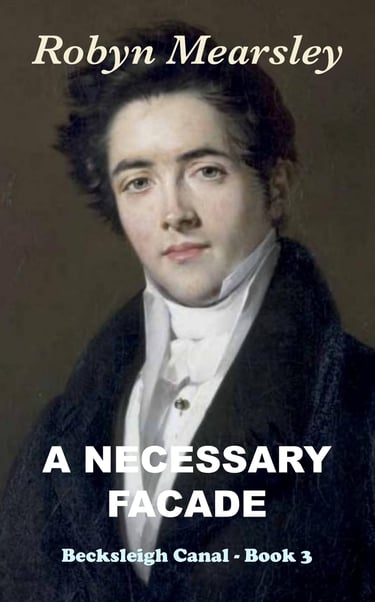
Miss Alice Leyland—a petite young lady with smiling blue eyes set in a delicately featured face—sat alone at the breakfast table in Lord and Lady Simmington’s elegant London townhouse, which was located within easy reach of fashionable Hyde Park. Already at seven o’clock in the morning, the sounds of the teeming metropolis—horse hooves and carriage wheels on cobblestone and humans in full cry—were defying the feeble barrier of brick walls and glass windows.
Even though she had arrived in London for the Little Season almost two weeks previously, Alice was only now adjusting to the constant rumble of the city, so very different from the peaceful sounds of nature—and of silence—to which she was accustomed on her parents’ estate. However, with each passing day, the clatter from outside was disturbing her less and less, serving rather to herald yet another day of exciting new experiences in the heart of this fascinating city.
But today, the din from outside made no impression on her at all. Conscious only of a thrill of excitement from another source entirely, she had risen early, despite a late night of singing and dancing. After dressing, she had hurried to the entrance hall and picked up a pure white calling card from a small elegant table, taking it into the breakfast room. The card had been left there the previous day while she and her companions had been out enjoying the pleasures of the town.
With slow fascination, she traced her forefinger over a delicately embossed oval that framed the name on the card, which was printed in graceful, flowing script. To Alice, everything about the card spoke of taste, refinement, and sophistication—just like its owner.
“Mr James Carey, Willowood,” she whispered, reading the card’s inscription.
She breathed a long sigh of pleasure. He had come—at last—to visit her in London just as he had promised four weeks earlier during his final visit to her parents’ estate near the remote inland town of Little Becksleigh.
Not for the first time, she was astonished at how deep an impression he had made on her after only three encounters. The first had been at a lively party at her parents’ house; the second had been in the Little Becksleigh churchyard after the morning service; and the third had been at his final visit to her parents’ house before he left the Becksleigh region.
Never before had she been so instantly attracted to a gentleman. Not that she had had a great deal of experience, of course, being only twenty years old, and resident her entire life in the Becksleigh region. But, remote as it was, the region was not a desert island. Quite a few young gentlemen lived in the area, and others visited from time to time. None of them, however, had set sparks flying within her—until the arrival of the handsome and stylish Mr Carey, with his direct and attentive gaze, his twinkling eye, his easy and humorous repartee, and most of all, his slightly roguish, satirical air. All of this had worked its magic on Alice, and she had responded in kind to his witty banter in her characteristic teasing manner.
Mr Carey’s visit to the Becksleigh region had lasted less than three weeks. He had come, so he said, to ‘cast an eye over’ his business investments in the region in the form of a road carrying company called ‘Beck Carriers’. For the first time, Alice thought how strange it was that such a sophisticated gentleman as Mr Carey should concern himself directly with the commonplace operations of a road carting business. Looking again at his calling card, she saw that it styled him as Mr James Carey of Willowood, clearly a landed estate of some significance. How unusual, she thought, that a gentleman of his standing would wish to publicly associate himself with such a lowly firm. Yet, he had done so.
Transport companies were of little interest to Alice, but she was aware that Mr Carey’s Beck Carriers coexisted uneasily with the Simmington Canal Company. The latter company had been formed several years previously to construct the Becksleigh Canal, an important connector canal intended as a link between the established canal network to the south of the Becksleigh region with a similar network to the north. Simmingtons had already built the southern section of its canal where it connected to Little Becksleigh on the River Beck, and was now close to finalising the section between Little Becksleigh and the canal network to the north.
For more than a year, Beck Carriers had thrived by carting large volumes of goods and materials by road between the canal terminus at Little Becksleigh and the northern canal network. This had also benefited the canal company, enabling it to operate the southern section of its canal profitably while the northern section was being constructed. When this section was completed within the next few months, narrowboats would ply the whole waterway. This would render Mr Carey’s many wagons redundant, thereby throttling his business in the region.
Mr Carey had candidly acknowledged this during the party at her parents’ house in a conversation with the Simmington Canal Company’s operations’ director, Mr William Pearce—Alice’s cousin—and other guests. Carey had unashamedly stated that he hoped that the canal would take a very long time to complete.
Alice had been shocked to hear him seemingly wish misfortune on a project so important to her cousin, and had challenged him on it. She smiled when she recalled his open and frank response, so typical of his charm. “My dear Miss Leyland,” he had said, “merely by hoping, I will not affect the canal in the slightest. I may, for example, hope that it doesn’t rain tomorrow. But the elements won’t pay any attention to my desires. And I’m sure the canal builders hope to finish the canal early rather than late, which wouldn’t suit me at all. But, I take no offence at that, and am happy to stay on the most cordial terms with everyone involved.”
Nevertheless, it was clear to Alice that there was tension between the two companies. Her friend, Alexander ‘Sandy’ McBride, the engineer in charge of construction on the Becksleigh canal, had been viciously attacked by two thugs employed by Beck Carriers, and McBride had recuperated at her parents’ house. Alice knew that he suspected Carey—most unfairly, in Alice’s view—of complicity in the attacks, and in other violent sabotage to canal worksites. Unfortunately, the two thugs who attacked McBride had escaped capture, and there was no clear evidence to connect anyone else with the crime. Carey, on hearing of the vicious attack on McBride, had visited him claiming to be shocked by the news, and he told McBride how mortified he was that the miscreants had been briefly employed by his company. Under the circumstances, McBride had no option but to accept his forthright apology, although Alice knew that he still regarded Mr Carey as a smooth-talking rogue.
But Alice found it impossible to believe that such a delightful and charming gentleman as Mr Carey could be capable of instigating acts of violence against McBride—or indeed, against anyone. He is a man who can be trusted, thought Alice, with a smile. He had told her that his business would take him to London and had asked if he could visit her there. When she had readily assented, he had replied, “Then visit you I shall, Miss Leyland.” And so he had, thought Alice, as she looked down at the card in her hand.
Turning the card over, she read the London address he had written in his neat hand. He was staying at the house of the Marquis of Hampton, a wealthy nobleman whose mother was a prominent and influential society matron. Alice’s hostess, Lady Simmington, after seeing the card, had immediately sent a footman to Lord Hampton’s residence, with a note for Mr Carey saying that she would be at home to visitors from eleven the following morning. Mr Carey had responded with a message of thanks, promising to call.
Alice sighed. “That’s more than three hours to wait,” she thought, wishing that she had slept in.
Excerpt from A Necessary Facade - Copyright © Robyn Mearsley 2026. All rights reserved - this work may only be copied by permission of the author
© 2026 Robyn Mearsley. All rights reserved.
© 2026 Robyn Mearsley. All rights reserved.