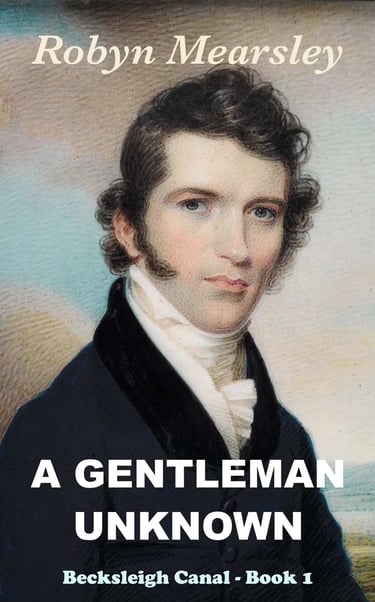
A Gentleman Unknown Excerpt
Book 1: Becksleigh Canal
The town of Much Becksleigh in rural inland England - early 1800s
“So Eleanor … have you heard?” asked Priscilla, leaning forward on her elegant sofa, her blue eyes sparkling in the morning sunlight.
“Well … I think I have,” said Eleanor, from the matching arm chair. “If you mean what I think you mean … do you?”
Priscilla released her breath. “Ah, so you have heard. Quickly, tell me what you know.”
“I know a little. It’s what my father told me last night.” Eleanor paused for a moment. “But perhaps I shouldn’t say anything given that father is a solicitor. He sets great store by proper professional confidentiality, and never discusses the particulars of his legal work with me. Nor does he introduce me to any of his clients.
“Yet strangely, on this occasion, he did speak of such things. In fact, Father specifically asked me to be pleasant and welcoming, if I meet … him.”
“Him,” intoned Priscilla. “And what did your father say about him?”
“Well, his name is Mr Pearce, Mr William Pearce. Father said he comes from a prominent landed family in Garthshire, and—”
“William Pearce … so that is his name,” said Priscilla. “I overheard Papa telling my aunt Rose that we may need to entertain an important young gentleman from out of town. Papa definitely said ‘young’ and ’gentleman’, but I didn’t catch the name. I worried he might turn out to be some merchant, or yet another stuffy, balding business associate. But if Mr William Pearce’s family owns a landed estate, then without doubt, he is a gentleman.”
“I suppose so. Although, according to my father, Mr Pearce is representing the Simmington Canal Company—you know the one—their engineers and surveyors have been poking around the local countryside for years now, on and off. Apparently, Mr Pearce wants to meet prominent members of the local community in order to tie up some loose ends—‘water rights’, I think Father said—so that construction of the canal can start.”
“Water rights?” asked Priscilla, wrinkling her brow. “What on earth are they, and what have they to do with a canal?”
“I don’t rightly know,” said Eleanor. “But canals do tend to have water in them. Quite a lot in fact.”
“Yes, I suppose the little boats do need something to float on.”
“Unquestionably. And you know how wet and boggy some of your father’s land gets after the least bit of rain. Perhaps Mr Pearce wants to use some of that water in his canal.”
Eleanor sat back in her chair. “My father also said that a new canal will speed the movement of goods and materials hereabouts. Apparently, canal boats move far greater loads than horses can carry. Father says this will bring a great deal of new business, so much in fact, that our little town of Much Becksleigh might well become an important market town.”
Eleanor chuckled. “Imagine … we may have to dispense with plain ‘Much’ and start calling it ‘Very Much’ Becksleigh, or perhaps ‘Much More’ Becksleigh. Father seemed quite excited, and as you know, he is usually the most calm and restrained of men.”
“Yes, yes,” said Priscilla with an impatient flick of her hand. “But Eleanor, none of this is the least bit interesting or important.”
“It isn’t?” asked Eleanor, in surprise.
“No. The important point—the really important point—is that a rich, handsome, young gentleman is coming to town, and my family will be entertaining him.”
“Oh Prissy … really!” Eleanor laughed, as did the third young woman in the room, who had been listening to her friends’ conversation with a wry expression on her face.
She was dressed more soberly than her friends, whose morning dresses were modishly decorated, albeit in a provincial manner. She looked like a rather severe parson’s daughter, which in fact she was, being the Reverend Matthew Broadbent’s daughter Ruth. The vicar was quite a force in the local community, advocating with great fervency for the moral and social reforms of the day—as did Ruth.
“Why, whatever is the matter?” asked Priscilla.
“Priscilla,” said Ruth, as though to a child, “how you carry on. We know very little about the man. I agree he may be a gentleman, but there is little reason to suppose he is rich, and absolutely none to imagine he is handsome. Very few people are extravagantly good-looking, you know—yourself excluded, of course.”
“Perhaps,” said Priscilla, taking her flawless golden-haired beauty as given. “But, that doesn’t mean he isn’t rich and handsome. And the more I think about it, the more certain I become.”
She sprang to her feet. “Wait, I know something else about all this—I’m sure I do. Eleanor, what was the name of that canal company?”
“It’s called the Simmington Canal Company.”
“Simmington, Simmington … where have I seen that name before? Yes, of course! I have it now. Simmington must be the Viscount Simmington.”
“Who? I’ve never heard of such a person,” said Ruth, by far the most knowledgeable of the trio. “Priscilla, how can you possibly know such a thing?”
“Simple, the family is listed in Debrett’s Peerage. You know, the guide to all the peers of the realm. I read it every day.”
“Do you?” said Ruth, with a sad shake of her head. “Is that before or after you read from the book of sermons I gave you? Really Priscilla, I despair of you.”
“But don’t you see?” asked Priscilla, with a blush. “Viscount Simmington’s principal seat is in Garthshire. That is where Mr Pearce comes from. So the viscount must own the canal company. It’s simple logic.”
“Very simple logic,” said Ruth, her face even more dour than usual.
“But do viscounts own canals?” asked Eleanor.
“It’s possible,” conceded Ruth. “Some fifty years ago, the Duke of Bridgewater built a large canal near Manchester to carry coal from his mines in the hills. But he was a duke and fabulously wealthy. If, and I say if, this Lord Simmington is in the canal business, I suspect he would be collaborating with a number of other wealthy investors.”
“So it’s certain then,” said Priscilla, smiling in ecstasy. “Mr William Pearce—whom my family will be entertaining—consorts with nobility. Perhaps—oh perhaps, he may be related to the viscount.”
“Priscilla, you are going much too fast. This is all wild speculation. Calm yourself, do,” said Ruth.
“Yes indeed, Prissy,” said Eleanor. “Goodness. That a visit by some unknown gentleman on a business trip can excite such—such wild imaginings. It shows just how little happens in our remote corner of the world that we can waste our time speculating about him. I suspect that the truth about your fine gentleman may be quite the opposite to your imaginings. If he really is a so-called gentleman connected with the nobility, then he is bound to be feckless, arrogant and unfeeling.”
“Now who is the one indulging in wild imaginings?” asked Priscilla.
“I’m not! Young men of that rank are always worthless parasites.”
“Eleanor! You’ve lived in Much Becksleigh all your life. You’re a solicitor’s daughter. What do you know of men of rank?”
Priscilla’s face softened. “What happened to you, Eleanor? A year or so ago, it would have been me restraining you from ‘wild imaginings’. You would have been the one conjuring up exciting possibilities about Mr Pearce. But …” she continued in a gentle voice, “that was before you suffered your long bout of melancholy, wasn’t it? I remember how sad and listless you were at the time. It was so distressing to see you like that. And whenever I asked how I could help, you burst into tears, and said that you were beyond all help.”
Eleanor’s body had stiffened. Her mouth hung open as though to speak, but no sound came out. Her eyes darted to meet Ruth’s.
“Yes, Priscilla,” said Ruth, “something did happen to Eleanor. She grew up. She left the girl behind and became a woman—a woman of sense and maturity, freed from romantic girlish daydreams.”
“Ruth,” said Priscilla, “I’m nineteen years old, only two years younger than Eleanor. Must I expect the terrible pain that Eleanor endured. You’re a woman of twenty-five. Did you suffer so?”
“Well … no, I didn’t. I always knew the Way, and my calling. Everyone comes to terms with the real world in different ways, Priscilla, but I hope—indeed I trust your path will be easier.”
“Thank goodness for that. Anyway, I’m not interested in the real world. I am determined to mould the world to my fancy—filled to overflowing with girlish daydreams.”
Eleanor laughed, coming back to life. “Oh Prissy, you’re such a delight. And perhaps I’m not quite as sober as Ruth suggests. I cannot help but be interested in a mystery gentleman arriving in our midst.”
“But when does he arrive?” asked Priscilla, “Did your father say?”
“Father expects him the day after tomorrow—”
“So soon!”
“—towards evening. Mr Pearce has reserved lodgings in town for himself and his man of business—some sort of attorney, I believe. Father represents some of the landowners in the area and the visitors will be in easy reach of his office in the town square.
“And,” she added, “Father said that Mr Pearce may spend part of his time here with the Leyland family.”
“The Leylands?” asked Ruth. “I assume you mean the John Leylands whose property lies across the River Beck, about a mile or so beyond Little Becksleigh?”
“Yes. Father said they are some sort of family connection of the Pearces.”
“Goodness,” said Priscilla, bouncing to her feet. “Then Helen and Alice Leyland must know all about him. We must visit them straight away.”
“Wait, Priscilla. We can’t simply descend on Mr and Mrs Leyland unannounced,” said Ruth. “I will send a servant to see if they will be at home tomorrow to receive the three of us.”
“The three of us?” asked Eleanor. “I have met the Leylands a few times at church, of course. But I would never presume to visit them. My father is only a solicitor—a working man they might pay to draw up a will or contract.”
“Eleanor,” said Ruth, “I have told you before that you make too much of these fine distinctions in rank. Your father is a professional man, well regarded in the local community for his integrity and wise counsel. And you are an intelligent, attractive and well-spoken young woman. I am well-acquainted with Mrs Leyland and her two daughters. In fact Helen Leyland—the eldest daughter—I count as a friend. I am sure they would be delighted to welcome you in their home.”
“Of course they would, Eleanor. And don’t forget,” said Priscilla, looking meaningfully at her, “your father is known to be a wealthy man—and you are his only child.”
“Priscilla, really. We don’t need to talk of such things,” said Ruth.
“Why ever not? My own father is an industrialist—a tradesman in the view of some. Yet we are widely accepted in the area (save only for a few narrow-minded social sticklers). And why? Because Papa is rich—rich enough to buy one of the largest estates in the area.”
This indecorous statement was greeted by an uncomfortable silence, but Priscilla rushed on.
“Eleanor, do come, please. It will be such fun. I will ask Papa if we can use one of our carriages. It is quite a distance to the Leyland’s place, and we can all go together.”
“Yes,” said Ruth, “we must go. It seems that change is coming to Much Becksleigh. Mr Pearce may be the first of many newcomers. We need to know what sort of man he—and his ilk—may be, and whether they will threaten the true religious spirit of our community.”
“But Ruth,” asked Priscilla, “why would they do that?”
“Because the outside world is full of those who are not properly moved by the Spirit, but merely pretend to faith. In fact, some of them, while claiming to be Christian, never attend church services or celebrate holy communion at all.”
“Goodness,” said Priscilla, “you mean that there are people in the world who are not constrained—I mean—choose not to go to church—and they get away with it?”
“Yes. But they won’t ‘get away with it’ in Much Becksleigh. The proper moral tone of our community will prevail.”
Excerpt from A Gentleman Unknown copyright © Robyn Mearsley 2025. All rights reserved - this work may only be copied by permission of the author
© 2026 Robyn Mearsley. All rights reserved.
© 2026 Robyn Mearsley. All rights reserved.